Bikepacking Essentials: 6 Tech & Safety Items Every Bikepacker Needs
The bikepacking essentials that most riders overlook are not the tent or the sleeping bag — those are obvious. The ones that actually strand people mid-route are the small items: a dead GPS with no phone mount backup, a flat tyre with no pump, a rear light that died in a tunnel. This guide covers the 6 bikepacking essential tech and safety items that complete any kit, all available on Amazon right now.
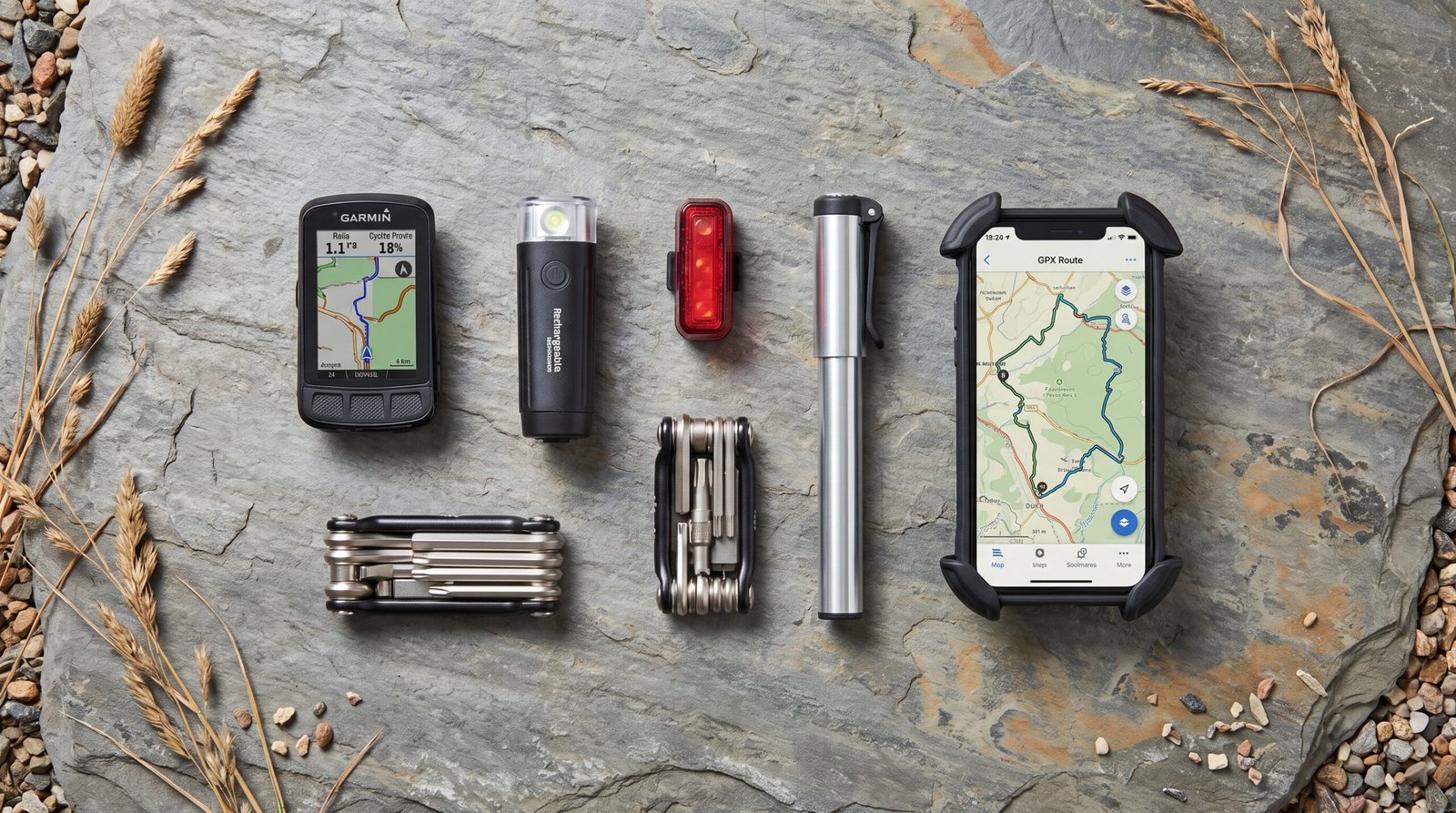
These bikepacking essentials sit between the big camping gear items and the bags that carry everything. They are the category most often assembled last and missed most often when they are gone. A GPS computer, front and rear lights, a cycling multi-tool, a mini pump, and a handlebar phone mount — six items, all under 200g individually, and collectively the difference between a self-sufficient bikepacker and one who needs rescuing.
If you have not sorted your bags and camping gear yet, start with the bikepacking bags guide and the bikepacking camping gear guide first. These bikepacking essentials are the final layer on top of those two systems.
6 Bikepacking Essentials for Tech & Safety (2026)
GPS Cycling Computer
A dedicated GPS cycling computer is the most important bikepacking essential in the tech category. Unlike a phone, it runs for 12-20 hours on a single charge, reads clearly in direct sunlight, survives rain without a case, and keeps navigating even when there is no mobile signal. For bikepacking routes that cross remote terrain, a GPS computer is not a luxury — it is the bikepacking essential that keeps you on the right trail when the path splits at midnight in the rain.
- 12-20 hour battery life — outlasts most full-day bikepacking stages
- Sunlight-readable screen — no squinting at a phone in direct summer light
- Waterproof to IPX7 — full rain submersion without a case or bag
- Offline maps — navigates without mobile signal in remote areas
- Mounts to the stem or handlebar — always visible, never in a pocket
Rechargeable Front Light
A high-output rechargeable front light is a non-negotiable bikepacking essential for any trip that involves riding before sunrise, after sunset, or through tunnels — which is most multi-day routes. On a bikepacking trip you do not control your finish time the way you do on a day ride. Weather, mechanicals, and harder-than-expected terrain push finishing times into darkness regularly. A 500-1000 lumen front light with a 4+ hour runtime on full beam is the bikepacking essential that keeps those delayed finishes safe.
- 500-1000 lumens — enough to see trail hazards at speed in full darkness
- 4+ hours on full beam — covers a long evening stage without recharging
- USB-C rechargeable — charges from a power bank in the frame bag overnight
- Multiple modes — full beam, eco, flash to manage battery across a long day
- Tool-free handlebar mount — installs and removes in seconds for charging
Rear Light
A rear light is the bikepacking essential that protects you from behind — tunnels, road crossings, and any shared road section at dusk or dawn. Bikepackers often carry a saddle bag that partially blocks the seat post mount position, so look for a rear light that mounts under the saddle, on the seat stay, or directly onto the saddle bag itself. The best rear lights for bikepacking are compact, run for 6+ hours in flash mode, and recharge via USB-C the same night as the front light.
- Compact design — under 50g, attaches to saddle bag, seat stay, or seat post
- 6+ hours in flash mode — one charge covers a full day’s riding and the evening
- USB-C rechargeable — same charging cable as the front light
- Daytime flash mode — visible from 500m+ in bright afternoon sun
- Multiple mount options — works around a large saddle bag without compromise
Cycling Multi-Tool
A cycling-specific multi-tool is the bikepacking essential that keeps mechanical problems from ending a trip early. Loose bolts, a dropped saddle, a shifted derailleur hanger, a creaking stem — all of these are fixed on the road with a 4mm Allen key and five minutes of attention, or they become a 40km walk to the nearest town. A good bikepacking multi-tool covers every bolt on the bike: Allen keys in 2, 3, 4, 5, 6, and 8mm, a Torx T25, a Phillips head, and a chain tool. That is the full set of bikepacking essential tools in one 80g package.
- Allen keys: 2, 3, 4, 5, 6, 8mm — covers every bolt on a modern bike
- Torx T25 — for disc brake rotors and modern groupset bolts
- Chain tool — fixes a broken chain without a separate tool
- Phillips and flat screwdrivers — for older components and accessories
- Under 100g — the most comprehensive bikepacking essential at this weight
Mini Pump & CO2 Inflator
A mini pump with a CO2 inflator backup is the bikepacking essential that handles the most common mechanical problem in cycling. Tubeless setups seal most punctures automatically, but not all — a sidewall cut or a puncture that overwhelms the sealant needs either a tube and a pump or a CO2 cartridge to get rolling again. The mini pump handles the tube inflation; the CO2 cartridge gets you back to pressure in 10 seconds for the ones that can’t wait. Both together weigh under 150g and fit inside the frame bag beside the multi-tool.
- Mini pump inflates to 80-100psi — adequate for road and gravel tyres
- CO2 inflator for emergency speed — full inflation in 10 seconds
- Compatible with Presta and Schrader valves — works on any bike
- Under 100g for the pump alone — lightest reliable bikepacking essential solution
- Fits inside the frame bag — always accessible, never buried in the saddle bag
Handlebar Phone Mount
A handlebar phone mount is the bikepacking essential that turns your phone into a navigation backup, a camera, and a communication device without taking your hands off the bars. Even if you ride with a dedicated GPS computer, keeping the phone accessible in a secure mount means you always have a backup map, the ability to call for help, and the option to photograph the route without stopping and digging through a bag. A good mount locks the phone solidly against rough trail vibration and pivots between portrait and landscape without tools.
- Secure lock mechanism — holds the phone against trail vibration and road buzz
- 360° rotation — portrait for maps, landscape for camera, no tools needed
- Fits 4.5–7 inch phones with or without a case
- Compatible with most handlebar diameters including oversized MTB bars
- Quick release — phone out in one motion for a call or camera shot
How to Pack These Bikepacking Essentials
Tech items mount to the cockpit
The GPS computer and phone mount both live on the handlebars — that is where they belong and where they work. The front light mounts to the handlebar or stem. Three of your six bikepacking essentials are cockpit items that install once and stay there for the whole trip. Check that they do not block each other’s view or interfere with the handlebar bag straps before leaving home.
Tools and safety items pack into the frame bag
The multi-tool, mini pump, and CO2 cartridges all pack into the frame bag — ideally in a dedicated side pocket or inner compartment where they are accessible without emptying the bag. The rear light clips to the saddle bag or seat stay. These three bikepacking essentials should be the last things in and the first things out at the start of every day, so you always know they are there.
Charge everything before you leave
The GPS computer, front light, rear light, and phone all need charging the night before departure. On a multi-day trip, the GPS and lights recharge from a USB power bank kept in the frame bag — a 10,000mAh bank weighs 200g and fully charges all three devices twice over. These bikepacking essentials are only essential if they have power, and power management on a long route is a skill worth developing before the first overnight camp.
The Complete Bikepacking Essentials Checklist
GPS computer on the bars. Front light and rear light charged. Multi-tool and pump in the frame bag. Phone locked in the handlebar mount. Six bikepacking essentials, all under 200g each, collectively under 700g — the complete tech and safety layer for any bikepacking trip.
For the bags to carry all your kit, see the bikepacking bags guide. For the camping gear to sleep at the end of the day, see the bikepacking camping gear guide. Three posts, three bag-loads, one complete bikepacking setup.