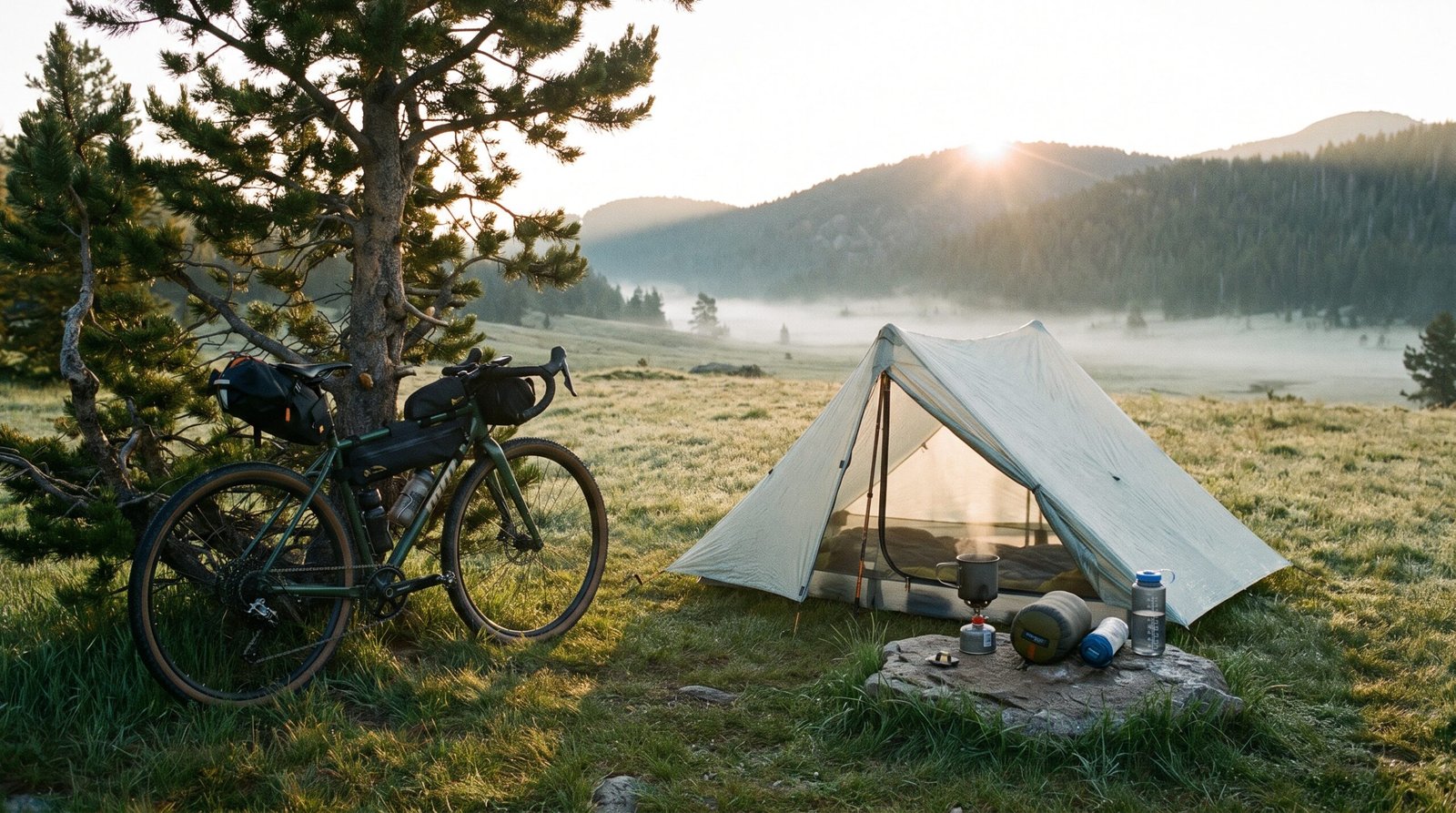
Bikepacking Camping Gear: 6 Essentials for Your First Night Out
The best bikepacking camping gear is the gear that disappears into the bags — ultralight, compact, and built for the specific constraints of a loaded bike. Every gram matters when it sits on a wheel instead of a back. Every litre of pack volume is space taken from another piece of kit. This guide covers the 6 essential categories of bikepacking camping gear for 2026, with the best Amazon pick for each one.
Good bikepacking camping gear solves two problems simultaneously: it has to perform in the field like proper camping kit, and it has to pack into a bikepacking bag system without blowing the weight or volume budget. That rules out most traditional camping gear immediately. These six picks are chosen specifically for bikepackers — not backpackers, not car campers, not festival-goers.
Before buying camping gear, make sure you have the bags to carry it — see the companion guide to bikepacking bags for the full bag system. And for your third post in the series, the bikepacking essentials guide covers navigation, lights, and tools.
6 Essential Bikepacking Camping Gear Picks for 2026
Ultralight Bikepacking Tent / Bivy
The shelter is the most important piece of bikepacking camping gear on this list — and the one where getting it wrong costs you an entire night’s sleep. A bivy or ultralight single-wall tent designed for bikepacking packs down to handlebar-bag size, sets up in under three minutes, and handles a full night of rain without leaking. The weight target for serious bikepacking camping gear shelters is under 1kg including pegs and pole. Above that, you feel it on every climb.
- Ultralight design — under 1kg total packed weight including pegs
- Single-wall or bivy construction — packs into the handlebar bag cleanly
- Sets up in under 3 minutes — no complex pole system or guy rope maze
- Waterproof rated for sustained rain — not just light drizzle
- Ventilation system — prevents condensation build-up inside overnight
Ultralight Sleeping Bag
An ultralight sleeping bag is the bikepacking camping gear item that determines whether you recover overnight or arrive at the next day’s ride already exhausted. Down sleeping bags pack smallest and warmest for their weight — the two metrics that matter most in a bikepacking camping gear setup. Choose a temperature rating 5°C lower than the coldest night you expect. Bikepackers run cold: you stop sweating the moment you stop riding, and mountain temperatures drop faster than most people plan for.
- Down fill — best warmth-to-weight ratio of any sleeping bag material
- Compresses to 2-3L packed — fits inside the handlebar bag alongside the tent
- Mummy cut — eliminates dead air space and keeps you warmer at the same rating
- Hydrophobic down treatment — stays lofted even in light moisture
- Temperature rated to at least 5°C / 41°F for three-season bikepacking camping
Ultralight Sleeping Pad
The sleeping pad is the most underrated piece of bikepacking camping gear on this list. Most new bikepackers buy a tent and a sleeping bag and forget that the ground conducts cold faster than the air does. A sleeping bag rated to 5°C is useless without a pad underneath it — the insulation compresses under your bodyweight and stops working entirely. For bikepacking camping gear purposes, an inflatable pad beats foam every time: smaller pack size, better insulation, and it rolls or folds to fit alongside the saddle bag or inside the handlebar bag.
- Inflatable construction — packs to the size of a water bottle, not a yoga mat
- R-value of 2+ — adequate insulation from the ground for three-season use
- Fits inside the saddle bag or strapped to the outside of the handlebar roll
- Repair kit included — a punctured pad on a bikepacking trip is a cold night
- Under 400g — the lightest bikepacking camping gear category for the protection it gives
Compact Camp Stove
A compact camp stove is the bikepacking camping gear item that separates a real camp from a cold bivouac. Hot food and coffee at the end of a 120km day change everything — recovery, morale, and warmth. A canister stove screws directly onto a standard isobutane gas canister and boils 500ml of water in under three minutes. For bikepacking camping gear, the entire stove-and-canister system should weigh under 200g and pack into the frame bag or a frame bag side pocket without using saddle bag volume.
- Screw-top canister stove — works with standard isobutane canisters worldwide
- Boils 500ml in under 3 minutes — fast enough for a wet, cold end-of-day camp
- Folds flat — packs into the frame bag or a jersey pocket
- Piezo ignition — lights first time without a separate lighter
- Under 100g for the stove head alone — the lightest hot-food bikepacking camping gear option
Bikepacking Water Filter
A water filter is the bikepacking camping gear item that gives you access to any stream, river, or lake as a water source — eliminating the weight and planning of carrying all your water from the last village. A squeeze-type or inline filter removes bacteria, protozoa, and particulates from raw water in seconds with no pump, no batteries, and no waiting. For bikepacking camping gear, the Sawyer Squeeze and LifeStraw designs are the standard — under 90g, fits in a jersey pocket, and filters up to 100,000 litres before replacement.
- Squeeze or inline filter design — no pump, no waiting, no batteries required
- Removes 99.9999% of bacteria and protozoa from raw water sources
- Under 90g — the lightest safety item in any bikepacking camping gear kit
- Rated to 100,000+ litres — lasts the life of the bike for most riders
- Compatible with standard water bottles and hydration bladders
Titanium Cookpot / Mess Kit
A titanium cookpot completes the cooking system in any bikepacking camping gear setup. It sits directly on the camp stove, boils water for rehydrated meals, cooks pasta or oats, and doubles as a mug for coffee. Titanium is the material of choice for bikepacking camping gear cookware: lighter than aluminium, stronger than anything else at this weight, and it never imparts a metallic taste to food or water. A 550-750ml pot with a folding handle and a lid that doubles as a plate covers every cooking need for a solo bikepacker.
- Titanium construction — lightest durable cookpot material available
- 550-750ml capacity — one full meal or two large mugs of coffee
- Folding handle — packs flat inside the frame bag with the stove head inside the pot
- Lid doubles as a plate or strainer — no extra bowl needed
- Under 100g — the lightest bikepacking camping gear cookware option at this capacity
How to Pack Bikepacking Camping Gear
The shelter and sleeping system go in the handlebar bag
The tent or bivy and the sleeping bag are the two bulkiest items in any bikepacking camping gear kit, and they both live in the handlebar bag. Pack the sleeping bag in a dry bag first, then roll the tent around it or alongside it. The handlebar bag is sized specifically for this combination — it is the largest volume position on the bike and the natural home for the biggest pieces of bikepacking camping gear.
The stove system packs into the frame bag
The camp stove, gas canister, titanium pot, and water filter all pack into the frame bag — ideally with the pot containing the stove head and the canister sitting in its own pocket. These are the dense, heavy items in a bikepacking camping gear setup, and keeping them in the frame bag maintains the bike’s centre of gravity. The sleeping pad rolls and straps to the outside of the saddle bag or sits inside the handlebar roll if volume allows.
Weight targets for a complete camp kit
A well-chosen bikepacking camping gear setup for three-season use should weigh under 2kg total: shelter 800g, sleeping bag 600g, sleeping pad 350g, stove + canister 200g, water filter 90g, cookpot 100g. That leaves meaningful room in the weight budget for food, clothing, and tools. If your bikepacking camping gear list is coming in above 2.5kg, look at the shelter and sleeping bag first — those are where most excess weight hides.
Your Complete Bikepacking Camping Gear List
Tent or bivy in the handlebar bag. Sleeping bag and pad alongside it. Stove, canister, pot, and water filter in the frame bag. Six pieces of bikepacking camping gear, all on Amazon, total weight under 2kg. That is the complete system for a first night out — and every night after that.
For the bags to carry all of this, see the bikepacking bags guide. For lights, navigation, and tools, see the bikepacking essentials guide. And for the right bike to build the whole kit around, start with the best commuter bikes guide.