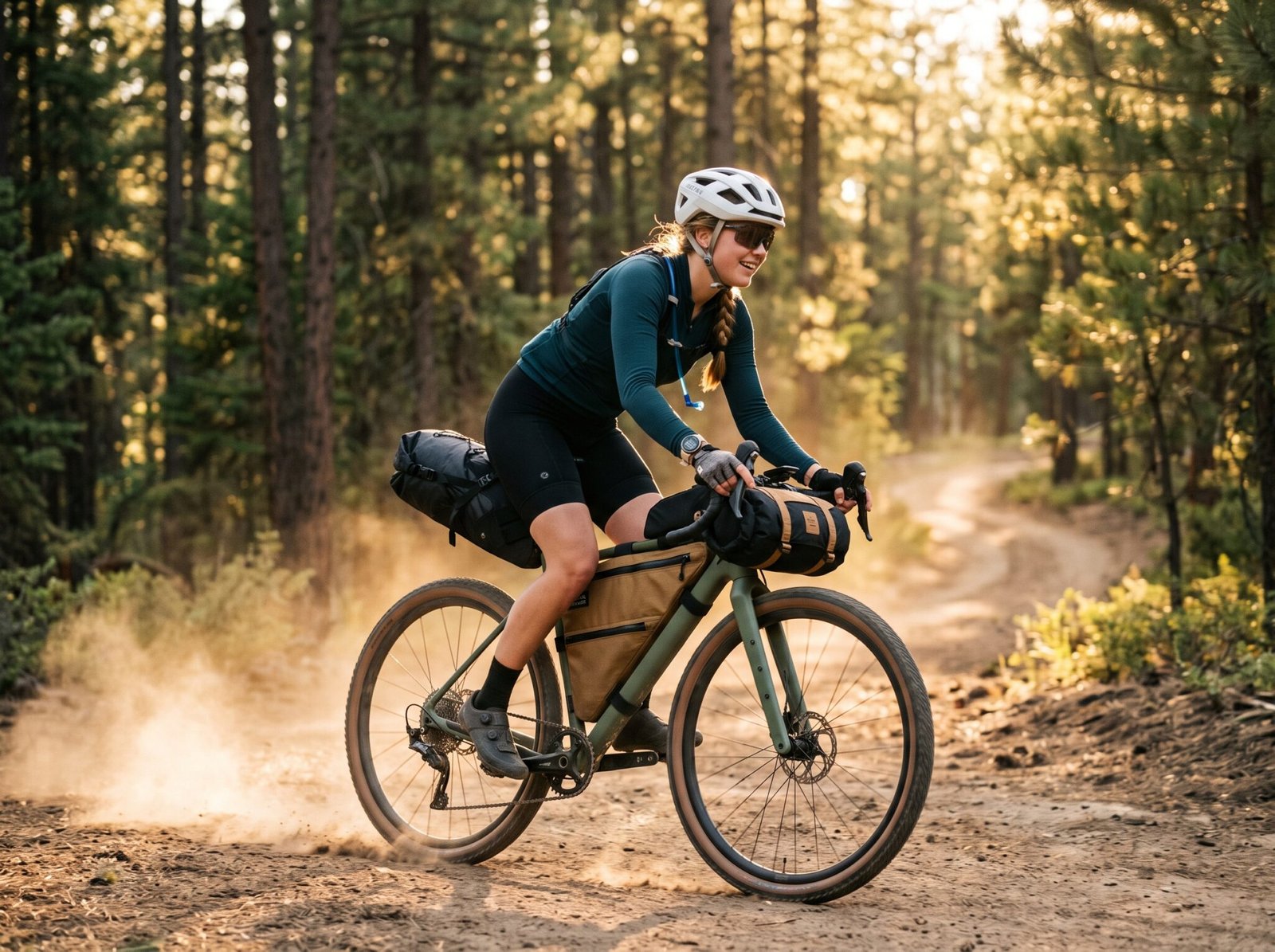
Best Bikepacking Gear 2026: 10 Essentials Worth Buying
The right bikepacking gear is the difference between a rough overnight and an easy one — and you don’t need a $3,000 touring rig to get it right. You need the right bags in the right places, a way to filter water, and a repair kit that fits in your palm. We combed Amazon’s bikepacking and cycling-accessory categories for the gear that keeps showing up as a genuine best-seller in its class, then grouped it into a kit that covers storage, survival essentials, and sleep & cook systems.
CyclistStyle is reader-supported. Some links below are Amazon affiliate links — if you buy through them, we may earn a small commission at no extra cost to you.
Build your storage first — a full-frame bag, a seat pack, and a handlebar bag — then add a top tube bag for snacks and your phone. Round out your bikepacking gear with Voile straps for anything that doesn’t fit in a bag, a Sawyer squeeze filter so you’re not carrying days of water, a compact multi-tool, and a sleep/cook system sized for how many nights you’re actually out.
1. Bikepacking Gear for Storage: Frame, Seat, Handlebar & Top Tube Bags
Bags are the bikepacking gear you’ll use on every single ride — they replace a rack and panniers by strapping directly to your frame, seatpost, and bars, for lower weight, no rattle, and no rack mounts required. Most riders build their kit in this order: frame bag first (your biggest, most stable volume), then a seat pack, then a handlebar bag, then a top tube bag for anything you want without stopping.
Rhinowalk Triangle Frame Bag — Best Full-Frame Bag
2.7L · Full Frame
A 2.7L triangle bag built in three layers — fully waterproof 600D polyester/TPU on the outside, a 1mm PE reinforcement plate in the middle to stop it sagging into your pedal stroke, and a waterproof inner lining. It mounts with a knob-and-elastic-cord system that goes on and off without tools, which matters when you’re switching the bag between bikes.
Best for: riders who want one bag to carry the bulk of their tools, food, and layers, rather than splitting weight across several small ones.
Topeak BackLoader 10L — Best Seat Pack
10L · 508g · 5kg max load
The seat pack is where most bikepacking setups go wrong — overloaded, it swings with every pedal stroke. The BackLoader fixes this with an upgraded saddle-rail mount plus compression straps that visibly cut the pendulum effect on rough ground. Inside is a 10,000mm-rated waterproof liner with an air-purge valve so you can actually compress it down once it’s packed.
Best for: your sleeping bag, bivy, or puffy jacket — the soft, compressible stuff that doesn’t mind being squeezed.
Vincita Everywhere Handlebar Bag — Best Handlebar Bag
5L · Rigid Barrel
Soft handlebar rolls sag over time and start rubbing your front tire on rough terrain. Vincita’s version ships with a rigid foam spacer kit that keeps its shape fully loaded, so it stays clear of your tire and cables no matter how it’s packed. The wide-access zipper means you’re not fighting a dry-bag roll-top every time you need something.
Best for: your tent or tarp, plus anything bulky but light you want out of the frame bag.
PACK2RIDE Toprock Frame Bag — Best Compact Frame Bag
1L · Cordura 1000D
If a full-frame bag interferes with your dropper post, bottle cages, or a smaller frame, this 1L half-frame bag is the compromise. It’s hand-built from 1000D Cordura with water-repellent YKK Aquaguard zips, and the mount is deliberately over-engineered against rotation — it stays put on washboard gravel instead of twisting toward your knee.
Best for: smaller frames, or as a second bag alongside a seat pack and handlebar bag on a minimalist overnight setup.
ROCKBROS Waterproof Top Tube Bag — Best Cockpit Bag
840D Nylon · One-Hand Access
This sits right behind your stem for anything you want without unclipping — phone, gels, a multi-tool. It’s built from 840D waterproof nylon with internal fiberboard supports so the bag holds its shape rather than collapsing when it’s half-empty, and the zipper is designed for one-handed access while riding.
Best for: snacks, your phone, and anything you reach for mid-climb without stopping.
2. Straps, Water Filtration & Repair Kit
Bags only get you so far — the gear that actually gets you through a multi-day route is what holds odd-shaped items in place, keeps you hydrated from natural sources, and gets you rolling again after a mechanical.
Voile Straps 3-Pack — Best All-Purpose Lashing
15″/20″/25″ · Made in USA
Voile straps have been the backcountry standard since 1984 for a reason: UV-resistant polyurethane with an aluminum buckle, a semi-elastic pull that actually tensions instead of just wrapping, and a textured surface that won’t slip once it’s cinched. Use them to lash a tent, sandals, or a jacket to the outside of a bag that’s already full.
Best for: anything odd-shaped that doesn’t fit inside a bag — and as a spare in case a buckle or strap fails elsewhere on the bike.
Sawyer Products PointOne Squeeze — Best Water Filter
0.1 Micron · Reusable
Carrying multiple days of water is the single heaviest thing you can do to a bikepacking setup. The Sawyer Squeeze weighs a few ounces, fits in a jersey pocket, and filters to 0.1 microns absolute — removing 99.99999% of bacteria and 99.9999% of protozoa like giardia and cryptosporidium. It backwashes with the included plunger to restore flow rate, so one filter lasts a very long time.
Best for: routes with reliable natural water sources — streams, lakes, taps of unknown quality — where refilling beats hauling.
Crankbrothers M19 Multi-Tool — Best Repair Tool
19 Functions · Compact
Nineteen tools in a single stainless steel body — hex keys, screwdrivers, Torx bits, a spoke wrench, and chain-breaking utility — built to handle roadside repairs from a loose bolt to a snapped chain link. It’s small enough to disappear into a top tube bag and rarely needs a backup.
Best for: the one tool you carry on every single ride, bikepacking or not.
3. Sleep & Cook System
For overnighters and multi-day routes, what you sleep on and cook with has to earn its place in already-tight bag volume. These two are built specifically around weight and pack size.
Paria Outdoor ReCharge UL Sleeping Pad — Best Sleep System
72″x20″ · 2.5″ Thick · Insulated
An ultralight, insulated air pad with a tapered 72×20-inch sleeping surface and 2.5 inches of loft — enough cushioning for real sleep without the pack size of a self-inflating pad. It rolls down small enough to strap under a handlebar bag or slot inside a seat pack alongside your sleeping bag.
Fire Maple Polaris Cooking System — Best Cook System
Pressure Regulator · Piezo Ignition
A pressure-regulated backcountry stove that stays consistent in cold or windy conditions — a common failure point for basic canister stoves. Piezo ignition means no lighter fumbling with cold hands, and the compact pot support and stand pack down small for a frame bag.
4. Full Gear Comparison
Here’s how all 10 pieces of bikepacking gear compare side by side, from key spec to what each one is actually best suited for:
| Item | Category | Key Spec | Best For |
|---|---|---|---|
| Rhinowalk Triangle Bag | Frame Bag | 2.7L, 3-layer waterproof | Main storage |
| Topeak BackLoader 10L | Seat Pack | 10,000mm WP, 5kg max | Sleep gear |
| Vincita Everywhere | Handlebar Bag | 5L, rigid anti-sag | Tent / tarp |
| PACK2RIDE Toprock | Compact Frame Bag | 1L, Cordura 1000D | Small frames |
| ROCKBROS Top Tube | Cockpit Bag | 840D nylon, WP | Snacks / phone |
| Voile Straps 3-Pack | Lashing | 15–25″, USA-made | Odd-shaped gear |
| Sawyer PointOne Squeeze | Water Filter | 0.1 micron absolute | Natural water sources |
| Crankbrothers M19 | Multi-Tool | 19 functions | Roadside repairs |
| Paria ReCharge UL | Sleeping Pad | 72×20″, 2.5″ loft | Overnight comfort |
| Fire Maple Polaris | Stove | Pressure-regulated | Cold/windy camps |
5. Two Ways to Build Your Bikepacking Gear Kit
3 bags, no cook system
- Rhinowalk or PACK2RIDE frame bag
- Topeak BackLoader seat pack
- ROCKBROS top tube bag
- Voile straps + Crankbrothers M19
Full kit, self-sufficient
- All 5 bags for maximum split volume
- Sawyer filter — skip carrying days of water
- Paria sleeping pad + Fire Maple stove
- Voile straps for the tent you can’t fit inside a bag
6. Bikepacking Gear FAQ
Do I need a full bikepacking gear set to start?
No. A seat pack and a top tube bag are enough for a first overnight trip. Add a frame bag and handlebar bag once you know how much volume your route actually demands.
Is a water filter necessary if I’m riding through towns?
If your route has reliable refill points every day, you can skip it. On rural or remote routes, a squeeze filter like the Sawyer PointOne removes the need to carry multiple days of water weight.
How much weight should a seat pack carry?
Stick close to the manufacturer’s max load — 5kg for the Topeak BackLoader — and pack the lightest, most compressible items (sleeping bag, clothing) rather than dense tools or food, which are better suited to a frame bag closer to the bike’s center of gravity.
What’s the one tool I should never ride without?
A compact multi-tool with a chain-breaker function, like the Crankbrothers M19. Most roadside mechanicals — loose bolts, a dropped chain, a snapped link — are fixable with one tool if it has the right functions.
7. The Verdict: Best Bikepacking Gear for 2026
Our Take
This bikepacking gear list is deliberately ordered by priority, not price. Start with storage — a frame bag, seat pack, and top tube bag cover most overnight trips on their own. Add a handlebar bag once you’re carrying a tent, and layer in the Sawyer filter, Crankbrothers multi-tool, and Voile straps as your all-ride essentials regardless of trip length. The sleep and cook system only need to come out for genuine multi-day routes — don’t carry a stove for a single overnighter with a resupply in the morning.